When a vibration event lands on the Sensored dashboard it arrives with a handful of numbers beside it: peak acceleration, RMS, crest factor, duration and a dominant band. Engineers who are new to the platform tend to read the peak and stop. That is understandable, because the peak is the number that looks like damage. It is also the least informative of the set on its own.
This note explains what the three amplitude numbers measure, why we show all three, and how to read them together. None of it is exotic. It is the same arithmetic a vibration analyst runs in their head, written down so the whole maintenance team can run it too.
Peak: the worst instant
Peak acceleration is the largest absolute value the accelerometer saw during the capture window, in g. It answers one question: what was the hardest single hit? On a rail sleeper that is a wheel flat or a joint impact. On a pump bearing it is a rolling element crossing a spall. On a crane gearbox it is a tooth engaging badly.
Peak is honest about severity and dishonest about persistence. One stone under a wheel produces a spectacular peak and means nothing. A bearing that is genuinely failing may never produce a dramatic peak at all, because the damage is spread over hundreds of small impacts per second rather than one large one. Treat peak as a headline that needs a second source before you act on it.
RMS: the energy in the event
RMS is the root of the mean of the squared signal, again in g. It is the “loudness” of the capture: how much vibration energy the asset put out, averaged over the whole window. A train passing a sleeper produces a high RMS with an unremarkable peak, because the energy is broadband and sustained. A healthy pump at duty produces a low, very stable RMS, which is exactly why a slow drift in RMS over weeks is one of the most trustworthy early-warning signals we have.
RMS is the number to trend. It is far less sensitive to a single spurious hit than the peak, so a rising RMS across successive captures on the same asset, at the same duty point, is worth a work order in a way a single high peak is not.
Crest factor: how spiky the energy is
Crest factor is simply peak divided by RMS. It has no units and it is the number that separates the two stories above. A high peak with a high RMS gives a modest crest factor: a lot of energy, distributed. A high peak with a low RMS gives a large crest factor: most of the energy arrived in a few sharp spikes.
We use the following bands as a working rule, and they are the same thresholds the dashboard uses to colour the column:
- Below 3 — noise-like or random vibration. Healthy rotating machinery under steady load lives here.
- 3 to 5 — early impulsiveness. The first sign that something periodic is starting to strike, before it is loud enough to move the RMS.
- 5 to 10 — significant transients. Bearing spalls, loose components, wheel flats at low speed.
- Above 10 — a few sharp spikes dominate the whole capture. Rail-head defects, a badly damaged wheel, a mechanical strike.
The important property of crest factor is that it moves first and then moves back. A bearing in its early stages produces sharp, isolated impacts on a quiet background, so the crest factor climbs. As the damage spreads the background fills in, RMS rises, and the crest factor falls again even though the bearing is now much worse. A falling crest factor on a rising RMS is therefore not recovery. It is the damage becoming general.
Reading the three together
Put the three numbers in a row and the capture usually explains itself:
- High peak, low RMS, high crest — a single impact. Look for a cause outside the asset before you suspect the asset. Check the next few captures; if it does not repeat, close it.
- Rising RMS, stable crest — the whole machine is getting louder. Broadband: imbalance, misalignment, a foundation problem, or simply a change in duty. Compare against the baseline at the same operating point.
- Rising crest, stable RMS — the classic early bearing or gear-tooth signature. The energy is still small but it is arriving in hits. This is the window where planned replacement is cheap.
- Rising RMS, falling crest — damage that was impulsive has become general. Escalate.
The dominant band column then tells you where in the spectrum the energy sits, which narrows the mechanism further. The B1 to B7 note covers that side of the reading.
What this means for the alert
It is why we do not reduce an asset to a single traffic light. A threshold on peak alone generates a work order every time a stone hits a rail. A threshold on RMS alone misses the early bearing entirely. The alert that survives contact with a maintenance planner is the one that says which of the three moved, against that sensor’s own baseline, and for how many captures in a row.
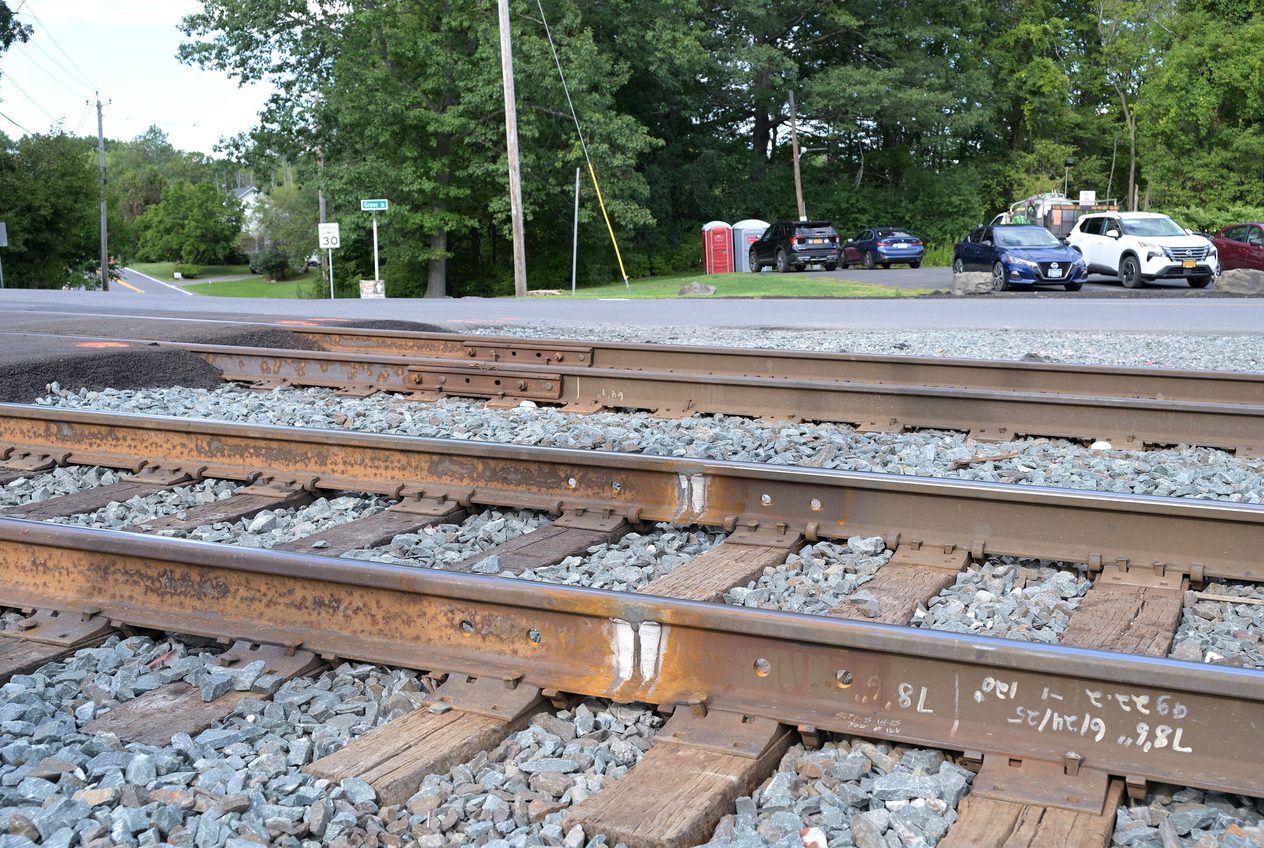
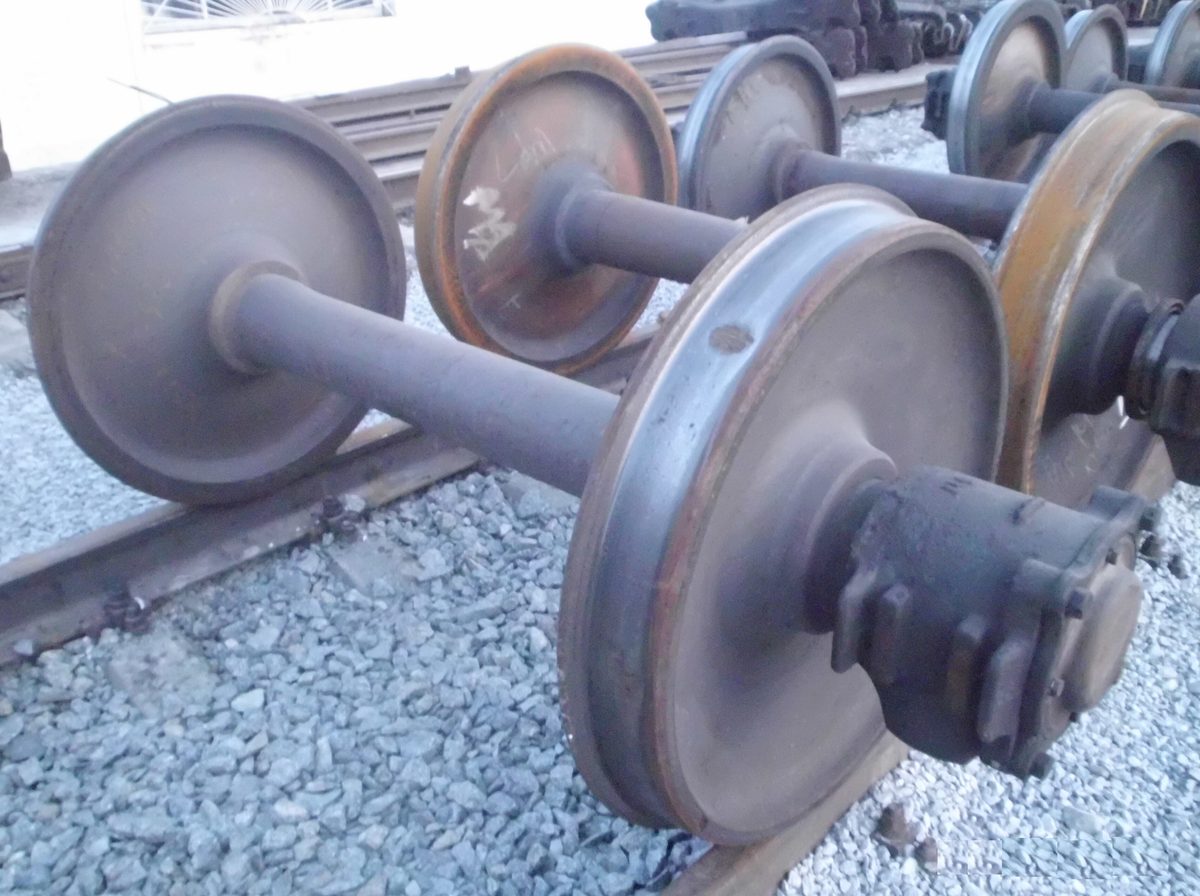
Images: Колёсные пары f001 by Ural-66, CC BY-SA 4.0, via Wikimedia Commons; Welded and jointed rail in Voorheesville August 2025 by 4300streetcar, CC BY 4.0, via Wikimedia Commons.